Advanced Handling Tuning Guide 2026
Vehicle handling in GTA 5 is controlled by the handling.meta file, a complex configuration system that defines every aspect of how a car drives — from acceleration curves to suspension behavior. This advanced guide for 2026 breaks down every critical parameter and teaches you how to create realistic or arcade-style handling for any vehicle.
Core Handling Parameters
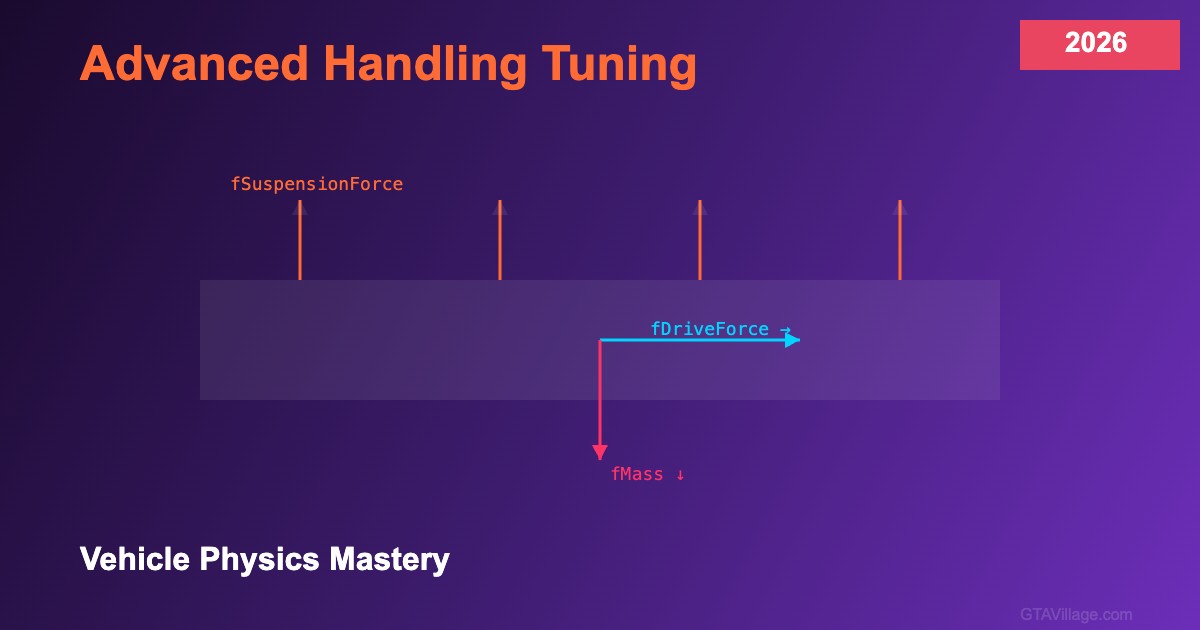
The most impactful parameters include fMass (vehicle weight affecting acceleration and collision physics), fDriveForce (engine power output), fBrakeForce (stopping power), and fTractionCurveMax/Min (grip levels at different speeds). Start tuning by adjusting fMass to match realistic vehicle weights — a sports car around 1400-1600, an SUV around 2200-2800. Then balance fDriveForce against fMass for the desired acceleration feel.
Suspension and Stability
Suspension parameters control ride quality and cornering behavior: fSuspensionForce determines spring stiffness (higher values = stiffer ride), fSuspensionCompDamp controls compression damping, and fSuspensionReboundDamp affects rebound. For sports cars, use high values (2.5-3.5) for responsive handling. For trucks and SUVs, lower values (1.0-1.8) create a softer, more realistic ride. Anti-roll bar strength (fAntiRollBarForce) prevents excessive body roll in corners.
Traction and Tire Physics
Traction curves define grip behavior: fTractionCurveMax sets peak grip, fTractionCurveMin defines grip at wheel spin, fTractionCurveLateral controls cornering grip, and fTractionLossMult determines how quickly grip degrades on loose surfaces. For drift-friendly handling, lower lateral traction and increase fLowSpeedTractionLossMult. For track-ready grip, maximize traction values and set fTractionBiasFront to distribute grip optimally between front and rear axles.
Testing and Fine-Tuning
Always test handling changes in a controlled environment: use a flat surface for acceleration tests, a figure-8 track for cornering evaluation, and steep hills for climbing power assessment. Make small adjustments (5-10% at a time) and test between each change. Document every modification in a spreadsheet so you can revert changes if needed. The best handling tunes come from dozens of iterative adjustments, not one-time configurations.



Comments0
Sign in to leave a comment
No comments yet. Be the first to comment!